
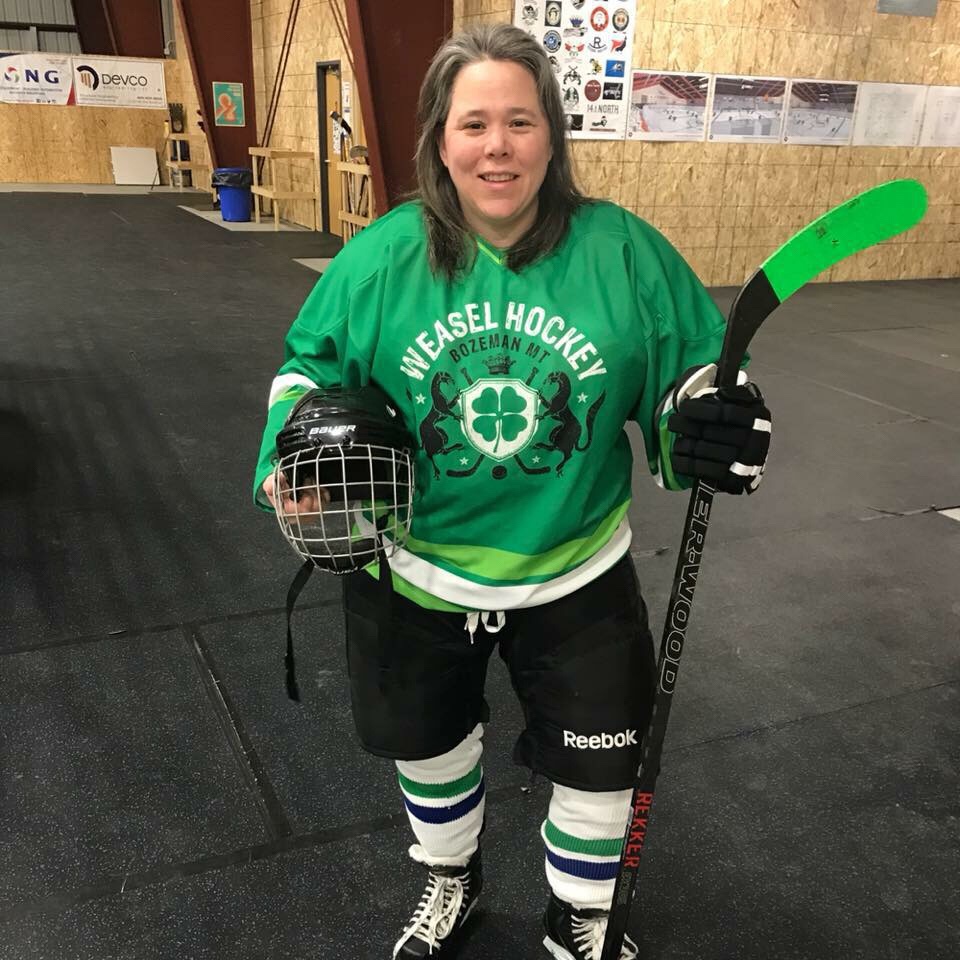
I was 39 years old with an infant strapped to my belly. We were bundled up, standing on the top row of bleachers, swaying back and forth and looking out onto the ice. Two bantam hockey teams were battling away, below us. We were the home team and sitting in front of us were a dozen or so parents and siblings. Our kids had been playing on teams together for years, so we were more than casual acquaintances, we had become hockey family.
When there was a brief lull in the action, my friend and fellow hockey mom, Tani, turned around and said, “Hey, Angela, my women’s hockey club is hosting a “Try Hockey Free” event in a couple of weeks. You should come out! It’s really fun.”
I chuckled as I responded, “uh, Tani, I don’t know about that. I can barely skate. I’m not exactly in great shape right now. And, I don’t even have any gear!”
“Oh, you’ll be fine. We will have extra gear at the event for you to borrow. It’s so much fun, and I know you could probably use a night out.”
She was right about me needing a night out. But at the time I was thinking more of along the lines of drinks with the ladies, rather than sweat and blood at the rink. I used to play roller hockey, way back in my early 20’s. It was an informal thing I would do with my friends. Once a week or so, we would take a study break and gather up at the Costco parking lot on the edge of town. The lights would stay on until just after 10pm, so we would set up a couple of portable goals and play a pick-up game for as long as we could. It was great exercise and involved a lot of laughing. But even back then, I wasn’t much of a skater, and we were on rollerblades.
“It does sound fun,” I said. “I’ll think about it.”
A couple of weeks later, I showed up. I think the trick was that I didn’t think about it too much. I just decided I needed something like this in my life. Something that would take me out of the home, family, and work routine. I was going to suck, but at least I would be sucking while playing the greatest game. Who could argue with that?
When I checked-in at the event they helped me gather all the necessary equipment in a huge hockey bag – helmet, chest protector, elbow pads, gloves, padded pants, knee pads, skates. I had brought a jersey, knit socks, and stick from my husband’s collection at home. I lifted the bag and slung it on my shoulder, so it was resting on my back. Then, I walked down the stairs to a long, drab hallway below the spectators’ seats. There was a row of dressing rooms, and we were assigned to letters C and D. I peeked into “C” and the benches were full of women and equipment. Everyone was in a different stage of getting dressed – sports bras, pads, socks and skates strewn around on the floor in front of them. There was no room for me in here, so I went next door. There was some open space down at the end of one of the benches, so I hoisted the massive bag as high as I could and stepped around hockey bags, weaving my way to the far side of the room.
Hockey gear has a smell that is other worldly. In addition to sweat, a hockey player is often covered with shaved ice from when their falls cause them to flail around on the ice. All the padding, hard-plastic, elastic and Velcro stays in a constant state of moisture, as it takes too long to completely dry between games and practices. Of course, where there is constant moisture there is bacteria and odors. So, as each hockey player enters the locker room and unzips their bag, the aroma that has been brewing inside is released for all to savor. These combined aromas make up the scent of a hockey dressing room.
I opened my bag and started to sort through the gear. For just a moment I thought, goodness, I don’t even know what order to put all this gear on. I nonchalantly looked around to see how everyone else was doing it and started dragging items out of my bag. Shin guards, knit socks, skates, oops. I need to put my hockey pants on before my skates. Pants, skates (tied as tightly as possible), chest protector, elbow pads, jersey, gloves, nope. First the helmet and then the gloves. By the time I got all my gear on, I was sweating. I was also the last one out of the dressing room. Only a few steps down the hallway and I realized my left skate was much too loose, and I would need to find a place to sit and re-tie it.
When I stepped on the ice, the rest of the ladies were taking some warm-up laps around the rink. Everyone was geared up from head to toe. I only had time for ½ a lap before Coach blew the whistle and we gathered at center ice. There were over 30 women who had showed up to try hockey that night, and a dozen or so experienced skaters there to help. Coach sent those of us who considered ourselves to be novice or first-time skaters to one end of the ice, and stronger skaters to the other side. We would work on some basic skills and then spend some time in a scrimmage.
We split into pairs and practiced passing the puck with a partner. We weren’t skating hard, but I began to feel my feet tighten and cramp. The pain stretched up into my calves and hips, settling in my lower back. When Coach gathered us for instructions on the next activity, I skated over to center ice and took a knee. I could rest my back and feet while I listened. Our next activity would be practicing our skating.
We all skated to one end of the rink and made 4 lines of skaters. I went to the back of a line, so I could observe the other skaters before it was my turn. Our first time down the length of the ice we would skate at a moderate speed, then when Coach blew her whistle we would skate as fast as possible to the line at the far end. When it was my turn, I skated at a moderate speed, when she blew the whistle I tried to pick up my pace, but I was already going as fast as I could. Our second time down the length of the ice, when Coach blew her whistle we would try to drop down and touch one knee on the ice, then stand back up and skate to the end. When it was my turn to do this, I dropped down to one knee and immediately realized I would not be getting back up. I spun out of control like a top skittering across the ice. When I stopped moving, I was able to push myself back up to standing using my hockey stick. This was basically the same or similar outcome for the rest of the skating drills we attempted that night.
By the time we took a water break and set up for our scrimmage I was dripping wet with sweat and melted ice, my heart was beating out of my chest, and I was sitting on both my knees at center ice. My feet and back, really my whole body was howling in pain. But, I had made it through almost ¾ of the practice. I was terrible, but I was celebrating. Seeing that I was at the very bottom of the barrel, I knew I only had room for improvement.
We would spend the last 15 minutes playing hockey. We sat on the players’ benches and would take short shifts out on the ice. Fortunately, having watched hundreds of youth hockey games, I knew most of the basic rules and where to play my position. I think I may have only touched the puck once or twice during that game, but I was skating for all I was worth to stay with my team. When the final whistle blew, we headed back to the locker room. There were huge, exhausted smiles all around and the room filled with laughter. There is something about common humility. None of us appeared to have any raw talent for hockey, but every single one of us felt like victors just because we tried.
I drove home, took a shower and went directly to bed. Adrenaline and joy were coursing through my veins and my legs throbbed because of over-exertion. It was hard falling asleep, so I lay in bed replaying all the memorable moments with a smile on my face. Eventually, I slipped away to sleep.
Last spring, I finished my 3rd season of hockey. I’ve played on women’s and co-ed teams, and even participated in a couple of women’s tournaments. Hockey is such a tremendously difficult sport to pick up in later life. My goal for each season has always been personal improvement. My first season I was thrilled to learn how to hockey stop. My second and third seasons I have improved all-around as a player, but I’ve also made progress in my backwards skating. Even with the slow progress, hockey has become one of my favorite hobbies.
Hockey demands everything from its players. Just stepping onto the ice requires strength and balance. The skating, passing, and shooting requires gross and fine motor skills. Then add the opposing team, and you need to be prepared to be vigilant, stand strong, and strategize on the fly. Every goal is hard earned. Blocked shots call for self-sacrifice. Your body will take a beating. You pour yourself out completely for 60 seconds, then race back to the bench to let the next line take their turn. There’s time for a drink, a cheer, and back on the ice again. Over and over, for 60 minutes, the intervals captivate you. There is no time to think about work, your phone messages, or dirty dishes in the sink. Life’s concerns fade away while your heart races and sweat trickles down the back of your neck.
I recently had a friend comment on a picture of me on the ice. She noticed that I always have the biggest smile on my face when I’m playing hockey. It’s true. And it’s because hockey is by far, my best workout and the most fun 60 minutes of my week.